
Final Thoughts: Can HR crack $1,200 and other trends to watch this summer
Volume, which is usually a big positive for buyers in price negotiations, has arguably become a net negative.



Volume, which is usually a big positive for buyers in price negotiations, has arguably become a net negative.

JSW Steel USA CEO Rob Simon will join Steel Market Update (SMU) for a Community Chat on Wednesday, June 3, at 11 am ET.
Sheet prices continue to rise in a market that remains characterized by extremely limited spot availability, solid demand, long lead times, and the lowest sheet inventories since May 2021.
SMU released its latest steel market survey results on Friday. The main takeaway: the stronger for longer narrative is still very much in the house.
U.S. Steel plans to increase prices for seamless oil country tubular goods (OCTG) by $300 per ton.

The United States International Trade Commission (ITC) has voted to continue investigations into oil country tubular goods (OCTG) from Austria, Taiwan, and the United Arab Emirates (UAE).
Inventories are getting dangerously low. (Sheet stocks are at their lowest point since May 2021!) Lead times remain extended. And mills have few spot tons available. (The ‘a’ word – “allocation” – is being kicked around.)

US Commerce Secretary Howard Lutnick said the US should pursue separate, bilateral trade negotiations with Canada and Mexico instead of renewing the US-Mexico-Canada Agreement (USMCA).

The Iran war and the blockade of the Strait of Hormuz have sent oil and aluminum prices soaring higher. The impact on steel has been mostly indirect but hardly insignificant – especially when it comes to the costs of moving metal.
Century Aluminum CEO Jesse Gary said his company could start up its new smelter in Oklahoma ahead of schedule if the permitting process moved more quickly.
The current rally in sheet prices has lasted more than seven months, something without recent precedent. Unless your definition of recent includes the snapback in demand following the pandemic.
Sheet and plate prices remained on an upward trend as industry sources increasingly asked whether improved demand might be driving the market as much as limited supply.
I haven’t done a deep dive into our sentiment data for a little while. And it’s timely to do so now. Why? Because we’re seeing what I’ll call the inverted yield curve of steel buyers’ sentiment.
I attended the SAFE Summit in Washington, D.C., earlier this week. It was an out-of-this world event – and I mean that quite literally. There were serious discussions around building data centers in space.
Anton Posner, CEO of Mercury Resources, will join Steel Market Update (SMU) and Aluminum Market Update (AMU) for a Community Chat on Thursday, May 14, at 11 am ET.
In a Final Thoughts las week, I asked “Got Steel?” And if you’re looking for spot tons in June, the answer still isn’t obvious.
The flat-rolled steel market looks poised for continued gains despite widespread concerns about higher freight costs stemming from the Iran War, according to SMU's latest steel market survey.
Service centers held only 2.24 months of supply (49.3 days of supply) of sheet products in March, according to our latest figures. If you check our archives, you’ll see that's the lowest sheet inventories we’ve seen since June 2021 – which was hardly a bad year for steel.
Nucor announced its fuel surcharge for plate will be at least $10 per short ton, effective with shipments beginning May 1.
Sheet and plate prices increased yet again this week on an increasingly tight spot market. It's gotten so tight that some market participants say they're becoming more concerned about availability than about price.

Ken Simonson, chief economist for The Associated General Contractors of America (AGC), will join SMU for a Community Chat webinar on Wednesday, April 15, at 11 a.m. ET.
Remember the “Got Milk?” advertising campaign of the 1990s. Maybe we should start a “Got Steel?” campaign. Or maybe “Got Spot Tons?” would be more accurate, if less catchy.
What a local media report described as an "explosion" on Friday night at U.S. Steel's Gary Works in Northwest Indiana has not disrupted production or resulted in any injuries, that company said.
Ken Simonson, chief economist for The Associated General Contractors of America (AGC), will join SMU for a Community Chat webinar on Wednesday, April 15, at 11 a.m. ET.
Algoma Steel aims to increase plate prices by US$60 per short ton (CA$80/st), effectively immediately, according to a letter to customers dated Thursday.
More people expect hot-rolled (HR) coil prices to continue to climb. And most respondents to our last survey predict that prices will hit or even breach the $1,100 per short ton (st) threshold.
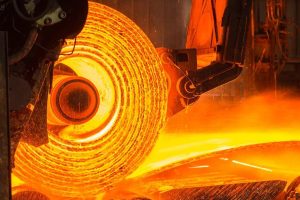
Sheet and plate prices continued to hold steady or tick upward once again this week. And the factors behind the gains are familiar ones: limited spot tonnage, stable demand, limited import competition, and outages (planned or otherwise) at domestic mills.
Nucor plans to increase its list price for hot-rolled (HR) coil to $1,040 per short ton (st), up $5/st from last week.
At least two major US plate producers - SSAB Americas and Nucor - plan to increase plate prices by at least $60 per short ton (st).
If I had to sum it up, I’d say “pain at the pump” is back. AAA says gasoline now averages more than $4 per gallon nationally ($4.08 to be precise) for the first time in for years. Meanwhile, diesel prices average $5.40 per gallon, according to the US Energy Information Administration. That’s up $1.81 per gallon from a year ago.