
Final Thoughts
When nations eye their trade policy these days, are they only seeing tariffs? It might seem that way, especially after reading a presidential executive order or five over the last year. But is the condition spreading?


When nations eye their trade policy these days, are they only seeing tariffs? It might seem that way, especially after reading a presidential executive order or five over the last year. But is the condition spreading?
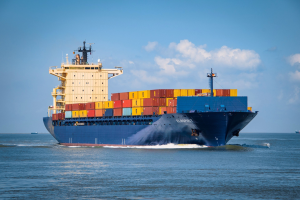
The UK will reduce steel import quotas and raise outside caps to 50%.
The Steel Manufacturers Association’s (SMA's) Philip K. Bell believes President Trump’s steel tariffs have been effective so far, and thinks we should remain “solution-focused” regarding the upcoming USMCA review.
The office of the US Trade Representative has opened a major Section 301 investigation into structural excess capacity across global manufacturing, with steel and aluminum at the center of the inquiry.
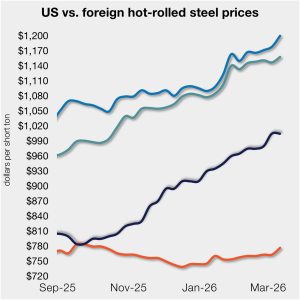
The price gap between US hot-rolled coil (HR) and landed offshore product widened this week, as stateside tags were little changed.
A year after being blindsided by hefty tariffs from its top trading partner, Canadian steelmakers are renewing their call for tariff-free trade between the US and Canada.

Earlier this week, SMU polled steel buyers on an array of topics, ranging from market prices, demand, and inventories to tariffs, imports, and evolving market events.

Sometimes it feels like current events are like a fireworks show that got set off all at once by mistake. In all the commotion, it's hard to know where to look... or where to run.
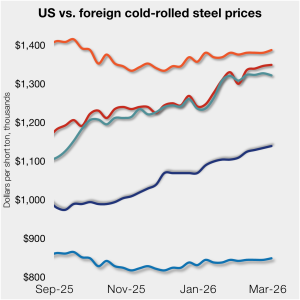
Cold-rolled (CR) coil prices ticked up in the US this week, matching a similar trend seen in most offshore markets as well.
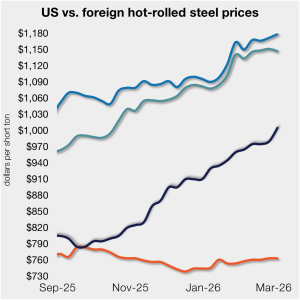
The price gap between US hot-rolled coil (HR) and landed offshore product tightened this week, as stateside tags continue to rise.
Since the Supreme Court struck down President Trump’s use of IEEPA tariffs, a judge at the Court of International Trade (CIT) has ordered refunds of all IEEPA tariffs. Still, Trump is trying again with a Section 122 global tariff.
Economic activity across the US increased at a light-to-modest pace in seven of the 12 Federal Reserve Districts, according to the US Federal Reserve’s latest Beige Book report.

The US surpassed Japan in annual steel production in 2025 for the first time in 26 years, according to the World Steel Association (worldsteel).

Tariff-related litigation in the US and around the world reflects the willingness of the president to act without consulting Congress or our trading partners. We're seeing the impulse to act without congressional approval in international relations too.

Entering 2026, tin has led a frenzied base metal rally during a historic phase for commodities. Frothy market conditions, driven by volatile investor positioning and shifting macro risk sentiment, pushed several metals—including tin—to record highs in January, before a sharp correction in February.
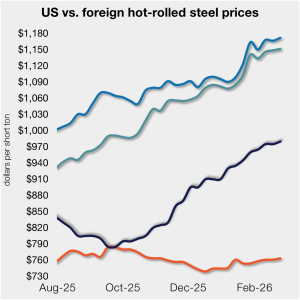
The price gap between US hot-rolled coil (HR/HRC) and landed offshore product remained largely flat again this week, as price movements stateside and abroad mirrored each other.

Leaders of the Steel Manufacturers Association (SMA) and the Canadian Steel Producers Association (CSPA) used this year's Tampa Steel Conference to outline the North American steel industry's central challenges: growing pressures, tariff realignments, and the upcoming USMCA review.

SMU’s Steel Demand Index slipped from earlier in the month, but remains above expansion territory, according to late-February indicators.

The wait for an answer is finally over (sort of). In a six-to-three decision, the Supreme Court invalidated the Administration’s use of the International Emergency Economic Powers Act (IEEPA) to impose tariffs.
On Friday, the Supreme Court released its long-awaited decision on the IEEPA (International Emergency Economic Powers Act) tariffs imposed by president Trump beginning last April. As most of you already know, by a six-to-three majority, the Court ruled against the president.

A look at some of the results of our most recent survey with market participant comments.
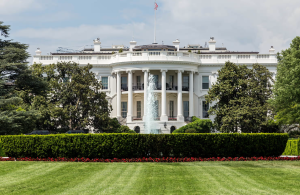
The latest 10% tariff is expected to be enacted over the next several days using Section 122.
SMU's Steel Buyers’ Sentiment Indices continue to show that steel buyers are optimistic for their businesses’ chances of success.

Waiting for possibly more changes to tariffs.

Barry Zekelman used his Tampa Steel Conference fireside chat to deliver one of the bluntest assessments yet of the forces shaping North American steel. He warned that a flawed tariff structure and an impending power crunch threaten the industry more than most realize.
The US House of Representatives voted on a resolution on Wednesday, Feb. 11, to disapprove of President Trump's national emergency declaration that led to the imposition of tariffs on Canada.
Last week, news stories (first in the Financial Times) appeared that the Trump administration was working on adjustments to steel and aluminum derivative tariffs. Ostensibly, these tariffs are only imposed on the steel or aluminum “content” of derivative products. But Customs has not provided clear guidance on how to calculate content. Confusion and controversy are running rampant.
Strategic Resources also discussed its project in Quebec, which will include a 4-million-ton/year DRI-quality iron ore pelletizer. It also plans to build a plant to produce DRI, then convert it to pig iron in an EAF.
Hot-rolled coil hovering near $970 per ton could push toward $1,000, but Timna Tanners cautioned at the Tampa Steel Conference that anything “much above that” becomes difficult to sustain. Still, she argued that mills’ slow, disciplined price increases are working in their favor.
Earlier this week, SMU polled steel buyers on an array of topics, ranging from market prices, demand, and inventories to tariffs, imports, and evolving market events.